Not every aesthetic treatment suits every patient, and Ultherapy is no exception. The treatment works well for a specific profile of skin concern. Understanding whether that profile matches your own is a more useful starting point than simply deciding whether you want the results Ultherapy can produce.
This guide covers who tends to respond well, who may be better served by a different approach, and what factors influence outcomes.
The Ideal Candidate Profile
Ultherapy consistently performs best in patients with mild to moderate skin laxity and reasonable baseline skin quality. The treatment stimulates the body’s own collagen production, so patients who still have a functional collagen response tend to see more pronounced results.
The following characteristics are associated with better outcomes:
- Age range of mid-thirties to mid-fifties, though patients outside this range can also benefit
- Mild to moderate laxity along the jaw, neck, or brow
- Good overall skin health without significant sun damage
- Realistic expectations about gradual, natural-looking improvement
- No tolerance for surgical downtime or risk
The treatment does not require perfect skin. It works with the skin’s existing structure to stimulate improvement. But the degree of improvement is proportional to the capacity for collagen response, which varies between individuals.
Areas Ultherapy Treats
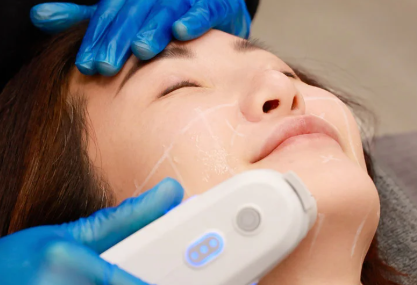
Ultherapy is cleared by the FDA for specific treatment areas. Understanding which areas it addresses — and which it does not — helps match the treatment to the right concerns.
| Treatment Area | What Ultherapy Addresses |
| Brow | Mild lifting of descended brow tissue |
| Chin | Improved definition and reduction of laxity |
| Neck | Tightening of loose skin along the neck |
| Chest/décolletage | Softening of lines on the upper chest |
| Cheeks | Mild improvement in skin firmness and texture |
Ultherapy is not used for volume restoration. If the primary concern is loss of facial volume — hollowed cheeks, deepened nasolabial folds, or lost lip definition — a different treatment such as dermal fillers addresses that concern more directly.
Who May Not Be a Strong Candidate
Several factors can reduce the suitability of Ultherapy or lower the expected response.
Significant skin laxity. Patients with very advanced sagging — excess skin that has lost substantial elasticity — may not see the degree of improvement that Ultherapy can offer. In these cases, surgical intervention typically produces a more satisfying result.
Heavy sun damage. Chronic sun exposure degrades collagen and reduces the skin’s capacity to regenerate it effectively. Patients with significant photodamage may respond less well to the collagen stimulation that Ultherapy relies on.
Active skin conditions. Open wounds, active infections, or inflammatory skin conditions in the treatment area are contraindications. Treatment is deferred until these have resolved.
Certain implants or devices. Patients with metal implants, pacemakers, or other electronic implants in or near the treatment area should discuss this with their doctor before booking.
Pregnancy. Ultherapy is not recommended during pregnancy. This is a standard precaution applied to most energy-based aesthetic treatments.
Managing Expectations Honestly
The results from Ultherapy are real and measurable. They are not equivalent to surgical results, and they appear gradually rather than immediately.
A useful way to frame expected outcomes: Ultherapy produces the kind of improvement that makes people look refreshed and more defined, without producing changes that appear obviously treated. Colleagues and acquaintances may notice that someone looks well without being able to identify why.
For patients expecting an immediate and dramatic transformation, this framing is an important check. The improvement at three months looks different from the improvement at one month, and both look different from the morning after the session.
Combining Ultherapy With Other Treatments
Ultherapy is frequently used alongside other aesthetic treatments as part of a broader maintenance approach.
Common combinations include:
- Ultherapy with Thermage — addressing laxity from both the deep tissue and the skin surface
- Ultherapy with dermal fillers — fillers restore volume while Ultherapy addresses structural laxity
- Ultherapy with Pico Laser — the laser addresses surface texture and pigmentation while Ultherapy works on the deeper structural layers
These combinations are decided based on individual assessment rather than a standard protocol. A qualified aesthetic doctor evaluates the presenting concerns and determines which treatments address which aspects of the overall picture.
Making the Decision
The most reliable way to determine candidacy is a face-to-face consultation with a qualified doctor who can assess tissue quality and laxity grade directly.
For anyone researching Singapore ultherapy options, this consultation step is worth taking before booking a session. The questions worth asking include which specific areas will benefit most, what degree of improvement is realistic given the current skin condition, and whether any complementary treatments would strengthen the overall result.
Final Thoughts
Ultherapy suits a specific profile of patient and a specific degree of skin concern. Within that profile, it is a well-evidenced treatment with a clear mechanism and a predictable result pattern.
Understanding the candidacy criteria honestly — including the situations where it performs best and the situations where a different approach may be more appropriate — is the foundation of a good aesthetic decision.
Meta Title Is Ultherapy Right for You? A Practical Candidacy Guide
Meta Description Find out whether Ultherapy suits your skin concerns, who responds best to the treatment, and what factors affect outcomes before booking.